Stacey Park Milbern Quarter: Value, Mintage and Errors
The 2025 Stacey Park Milbern quarter is worth 25 cents in circulated condition. 154,200,000 were struck, 94,800,000 at Philadelphia and 59,400,000 at Denver. That is the second-lowest mintage in the series, behind only the Dr. Vera Rubin quarter.
What this coin looks like
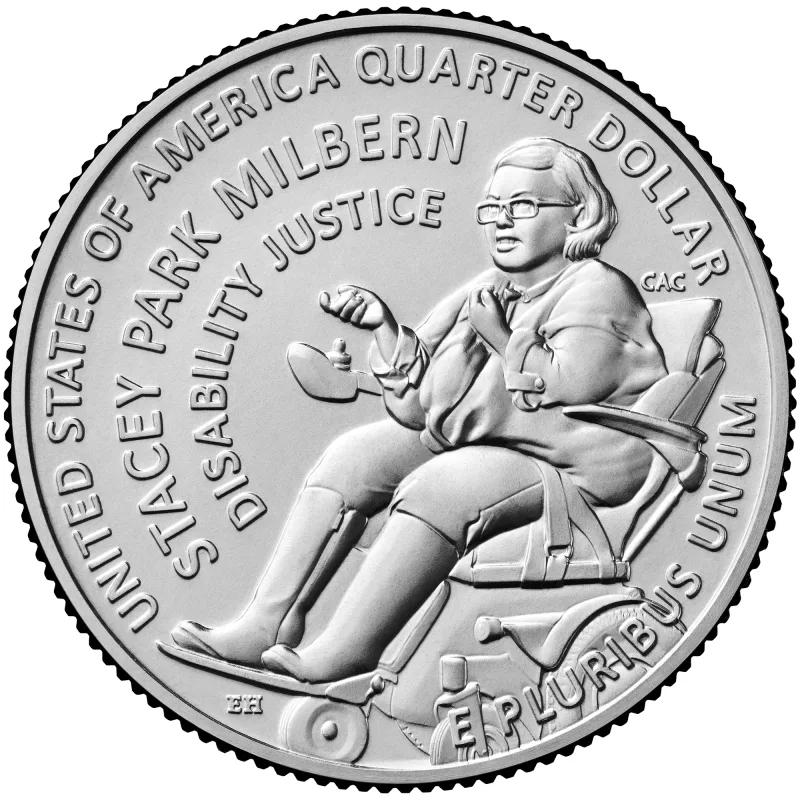
Elana Hagler's reverse shows Milbern in her power wheelchair, mid-speech, one hand raised and open. The chair is rendered in full, controller and all, rather than cropped away or hidden behind a podium.
That choice is the design. The two words at the left, DISABILITY JUSTICE, name a movement she helped define, one whose argument is that access is not a favor granted to disabled people but a condition of a functioning society. Craig A. Campbell sculpted it.
The reverse inscriptions read:
- UNITED STATES OF AMERICA
- QUARTER DOLLAR
- STACEY PARK MILBERN
- DISABILITY JUSTICE
- E PLURIBUS UNUM
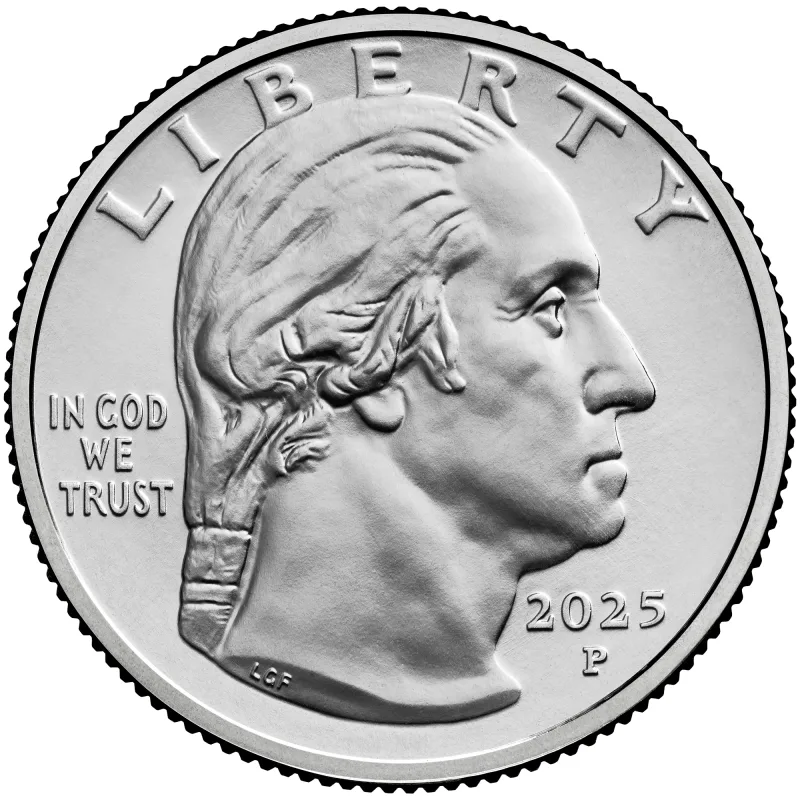
The obverse is the same on all 20 coins in the series: George Washington facing right, with LIBERTY, IN GOD WE TRUST, the date and the mint mark. The mint mark is to the right of Washington's neck, below the date. P is Philadelphia, D is Denver, S is San Francisco and appears only on proof and collector issues.
Is my Stacey Park Milbern quarter an error?
No error or variety unique to this coin is documented in the grading-service and variety sources this site checks. That is the normal situation: only five of the 20 designs (Sally Ride, Wilma Mankiller, Edith Kanakaʻole, Bessie Coleman and Mary Edwards Walker) have a documented error or variety.
What people most often bring to this coin are the three claims that attach to every coin in the series: a faint G in IN GOD WE TRUST (not an error, it is the typeface), flat shiny doubling on the lettering (machine doubling, not a doubled die), and small raised lumps from die chips. The errors page has nine tests that separate a genuine mint error from damage, and the short list of errors that are actually documented in this program.
What is it worth?
| Found in change | 25 cents |
|---|---|
| Uncirculated, from a Mint roll or bag | $1 to $2 |
| Certified mint state | A few dollars, rising to roughly $86 at the top of the population for the series |
| Clad proof (S mint) | Typically less than the cost of grading it |
| Silver proof (S mint, .999 fine) | A floor set by the silver price, plus a small premium |
Values as of October 2026. The full reasoning, including the four cases where a coin in this series is genuinely worth more, is on the value page.
How many were made
| Philadelphia (P) | 94,800,000 |
|---|---|
| Denver (D) | 59,400,000 |
| Total | 154,200,000 |
| Rank in the series | 2 of 20 by mintage, lowest first |
| San Francisco (S) | Not published by the Mint |
San Francisco (S) figures are not shown because the Mint has never published per-design mintages for S-mint American Women Quarters. Any S figure published elsewhere is a secondary-source estimate, and the two most commonly cited sets contradict each other.
See the full mintage table for all 20 designs, or the key date page for where this coin sits in the series.
Collector versions
Besides the Philadelphia and Denver coins in circulation, the Mint sold three San Francisco versions of the 2025 Stacey Park Milbern quarter directly to collectors. None were released into circulation.
| 2025-S uncirculated | Only in the 2025 three-roll set (40 P, 40 D, 40 S), $63.00 at issue |
|---|---|
| 2025-S clad proof | In the 2025 American Women Quarters Proof Set, $26.50 at issue, 33,927 sets sold |
| 2025-S silver proof | In the 2025 American Women Quarters Silver Proof Set, $95.00 at issue, 26,629 sets sold |
Set sales are as reported by CoinNews on 21 October 2026. Details on the proof and silver proof sets and the Mint rolls and bags.
Who was Stacey Park Milbern?
Stacey Park Milbern was born on 19 May 1987 at the U.S. Army hospital in Seoul, South Korea, to a Korean mother and a white American father serving in the Army. She grew up in a military family in North Carolina. She had Ullrich congenital muscular dystrophy from birth.
She was taking leadership roles in disability rights work by sixteen. In 2005, with other disabled queer women of color, she helped articulate what became the disability justice movement: a reframing of disability away from a medical problem to be accommodated and toward a question of who a society is built for. She served on the North Carolina Commission for the Blind and the Statewide Independent Living Council, and helped pass the 2007 state law creating Disability History and Awareness Month.
She took a degree at Methodist University in 2009 and an MBA at Mills College in 2015, by then living in the Bay Area. In 2014 President Obama appointed her to the President's Committee for People with Intellectual Disabilities. She worked as an impact producer on the 2020 documentary Crip Camp.
In March 2020, as the pandemic closed in, she and four friends formed the Disability Justice Culture Club from her home in East Oakland. They assembled and distributed disease-prevention kits, hand sanitizer, disinfectant and respirators, to homeless encampments, and ran mutual aid getting food and care to disabled people who could not get it any other way. She called that way of working crip wisdom: the practical knowledge that comes from a lifetime of improvising around systems not built for you.
She warned publicly that hospitals rationing care under pandemic pressure would ration it away from disabled patients first, and that people dependent on dialysis and ventilators were at risk from the triage policies being drafted.
Her own surgery, for fast-growing kidney cancer, was postponed under shelter-in-place orders. She died of complications on 19 May 2020, at Stanford hospital, on her thirty-third birthday. Google marked what would have been her thirty-fifth with a Doodle in 2022.
She was selected for defining disability justice as a movement and for organizing, in the last months of her life, the mutual aid that kept disabled people in her city supplied when institutions did not.
The design
| Reverse designer | Elana Hagler, U.S. Mint Artistic Infusion Program |
|---|---|
| Reverse sculptor | Craig A. Campbell, U.S. Mint medallic artist |
| Obverse | Laura Gardin Fraser, designed and sculpted, 1931 |
| Released | 11 August 2025 |
Specifications
| Composition, circulating | 91.67% copper, 8.33% nickel (pure copper core, copper-nickel outer layers) |
|---|---|
| Composition, silver proof | .999 fine silver |
| Weight | 5.670 g clad, 6.343 g silver proof |
| Diameter | 24.26 mm |
| Thickness | 1.75 mm |
| Edge | reeded, 119 reeds |
| Mints | Philadelphia (P) and Denver (D) for circulation; San Francisco (S) for proof and collector issues |
No American Women Quarter was struck in 90% silver. The Mint moved its silver proof sets to .999 fine silver with the 2019-dated issues, before this program began.
Frequently asked questions
- How much is the Stacey Park Milbern quarter worth?
- Twenty-five cents in circulated condition. An uncirculated example from a Mint roll or bag trades for one to two dollars.
- How many Stacey Park Milbern quarters were made?
- 154,200,000 in total: 94,800,000 at Philadelphia and 59,400,000 at Denver.
- When was the Stacey Park Milbern quarter released?
- It entered circulation on 11 August 2025.
- Who designed the Stacey Park Milbern quarter?
- The reverse was designed by Elana Hagler of the Mint's Artistic Infusion Program and sculpted by U.S. Mint medallic artist Craig A. Campbell. The obverse, shared by all 20 coins, is by Laura Gardin Fraser.
Sources
- Mintage figures: U.S. Mint circulating coin production dataset.
- Designer and sculptor credits: U.S. Mint, cross-checked against the artists' initials on the coin.
- Coin photograph: United States Mint image.
Last verified: October 2026. Mintage figures are final.