Dr. Vera Rubin Quarter: Value, Mintage and Errors
The 2025 Dr. Vera Rubin quarter is worth 25 cents in circulated condition. 118,800,000 were struck, 55,800,000 at Philadelphia and 63,000,000 at Denver. That is the lowest mintage of all 20 American Women Quarters, and the only one in the series under 150 million.
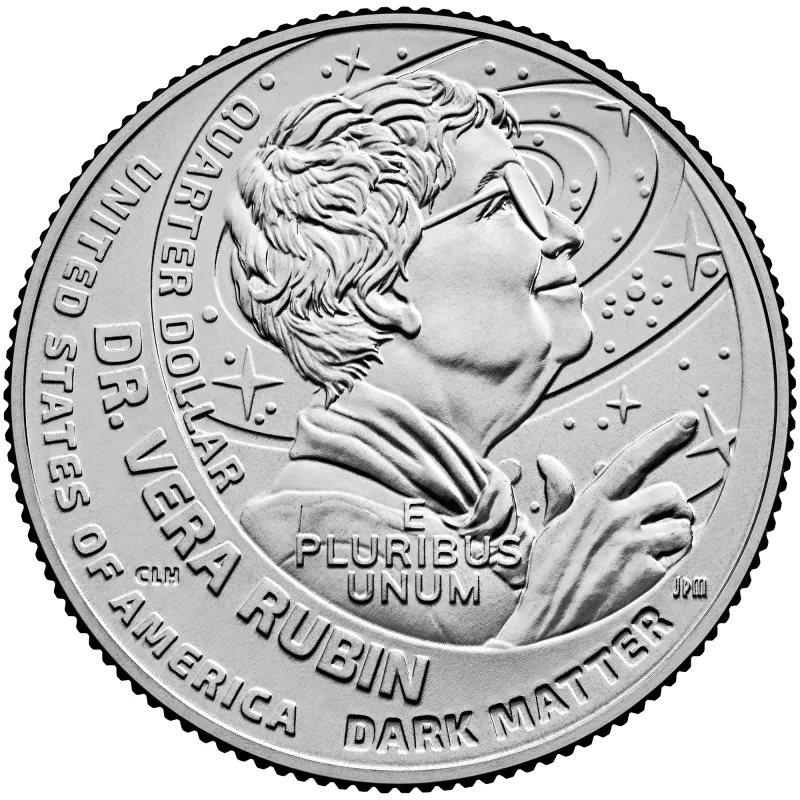
What this coin looks like
Christina Hess's reverse shows Rubin in profile looking up and to the right, one hand raised, set against a spiral galaxy whose arms curve across the whole field. The two words at the bottom edge, DARK MATTER, name the thing her observations forced astronomy to take seriously.
The design is unusual for the series in giving roughly half the coin to something other than the honoree. John P. McGraw sculpted it.
The reverse inscriptions read:
- UNITED STATES OF AMERICA
- QUARTER DOLLAR
- DR. VERA RUBIN
- DARK MATTER
- E PLURIBUS UNUM
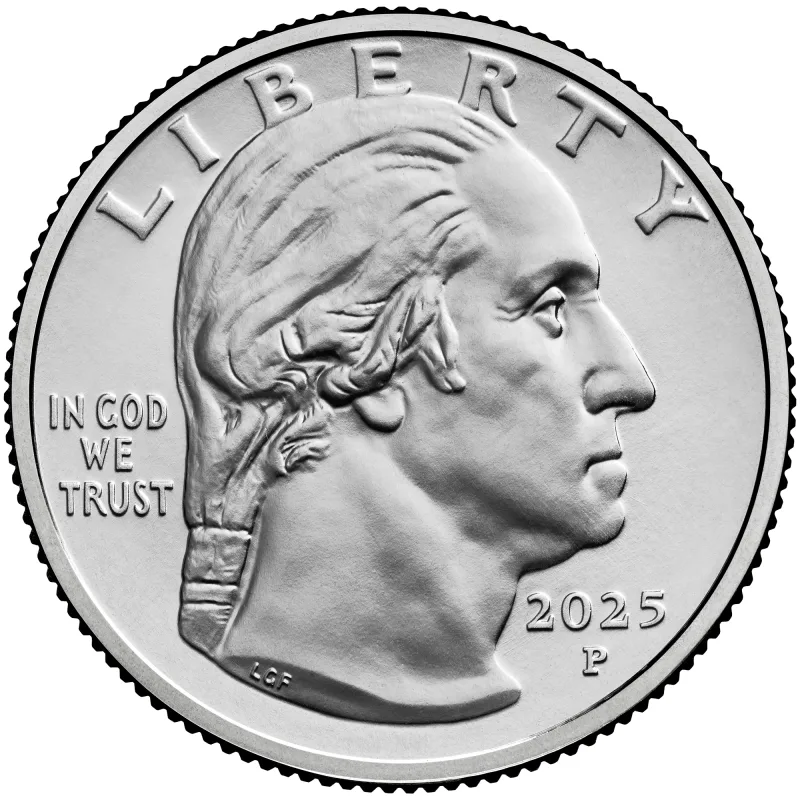
The obverse is the same on all 20 coins in the series: George Washington facing right, with LIBERTY, IN GOD WE TRUST, the date and the mint mark. The mint mark is to the right of Washington's neck, below the date. P is Philadelphia, D is Denver, S is San Francisco and appears only on proof and collector issues.
Is my Dr. Vera Rubin quarter an error?
No error or variety unique to this coin is documented in the grading-service and variety sources this site checks. That is the normal situation: only five of the 20 designs (Sally Ride, Wilma Mankiller, Edith Kanakaʻole, Bessie Coleman and Mary Edwards Walker) have a documented error or variety.
What people most often bring to this coin are the three claims that attach to every coin in the series: a faint G in IN GOD WE TRUST (not an error, it is the typeface), flat shiny doubling on the lettering (machine doubling, not a doubled die), and small raised lumps from die chips. The errors page has nine tests that separate a genuine mint error from damage, and the short list of errors that are actually documented in this program.
What is it worth?
| Found in change | 25 cents |
|---|---|
| Uncirculated, from a Mint roll or bag | $1 to $2 |
| Certified mint state | A few dollars, rising to roughly $86 at the top of the population for the series |
| Clad proof (S mint) | Typically less than the cost of grading it |
| Silver proof (S mint, .999 fine) | A floor set by the silver price, plus a small premium |
Values as of October 2026. The full reasoning, including the four cases where a coin in this series is genuinely worth more, is on the value page.
How many were made
| Philadelphia (P) | 55,800,000 |
|---|---|
| Denver (D) | 63,000,000 |
| Total | 118,800,000 |
| Rank in the series | 1 of 20 by mintage, lowest first |
| San Francisco (S) | Not published by the Mint |
San Francisco (S) figures are not shown because the Mint has never published per-design mintages for S-mint American Women Quarters. Any S figure published elsewhere is a secondary-source estimate, and the two most commonly cited sets contradict each other.
See the full mintage table for all 20 designs, or the key date page for where this coin sits in the series.
Collector versions
Besides the Philadelphia and Denver coins in circulation, the Mint sold three San Francisco versions of the 2025 Dr. Vera Rubin quarter directly to collectors. None were released into circulation.
| 2025-S uncirculated | Only in the 2025 three-roll set (40 P, 40 D, 40 S), $63.00 at issue |
|---|---|
| 2025-S clad proof | In the 2025 American Women Quarters Proof Set, $26.50 at issue, 33,927 sets sold |
| 2025-S silver proof | In the 2025 American Women Quarters Silver Proof Set, $95.00 at issue, 26,629 sets sold |
Set sales are as reported by CoinNews on 21 October 2026. Details on the proof and silver proof sets and the Mint rolls and bags.
Who was Dr. Vera Rubin?
Vera Florence Cooper was born in Philadelphia on 23 July 1928. She built her first telescope as a teenager with her father's help and watched meteor showers from her bedroom window, keeping records.
She took her degree at Vassar in 1948, the only astronomy major in her year. Princeton would not let her apply; its graduate astronomy program did not accept women until 1975. She went to Cornell for a master's in 1951, working on galactic dynamics, then to Georgetown for a doctorate in 1954 under George Gamow. Her dissertation argued that galaxies are not scattered at random through space but clump together. The idea was ignored for roughly two decades and is now standard.
In the 1960s and 1970s, working with the instrument-maker Kent Ford and his image-tube spectrograph, she measured how fast stars orbit within spiral galaxies, starting with Andromeda. The expectation was straightforward: stars far from the bright center should orbit slowly, the way outer planets orbit the Sun slowly. Instead the outer stars were moving about as fast as the inner ones. The rotation curves were flat.
The result held galaxy after galaxy. Either gravity behaved differently on that scale, or the visible matter was a small fraction of what was actually there. Her measurements indicated galaxies contain something like five to ten times more mass than can be seen. Fritz Zwicky had proposed unseen mass in the 1930s from a different line of evidence; Rubin and Ford supplied the observations that made it impossible to set aside.
She was elected to the National Academy of Sciences in 1981, the second woman astronomer admitted, and received the National Medal of Science in 1993 and the Royal Astronomical Society's Gold Medal in 1996, the first woman awarded it since Caroline Herschel in 1828. She pushed throughout her career for women to be hired, promoted and elected to the Academy, and counted that work as part of the job. She died on 25 December 2016.
In 2019 the observatory under construction on Cerro Pachón in Chile, previously the Large Synoptic Survey Telescope, was renamed the Vera C. Rubin Observatory.
She was selected for observations that changed what astronomers believe the universe is mostly made of, and for insisting that the field open to the women who came after her.
The design
| Reverse designer | Christina Hess, U.S. Mint Artistic Infusion Program |
|---|---|
| Reverse sculptor | John P. McGraw, U.S. Mint medallic artist |
| Obverse | Laura Gardin Fraser, designed and sculpted, 1931 |
| Released | 2 June 2025 |
Specifications
| Composition, circulating | 91.67% copper, 8.33% nickel (pure copper core, copper-nickel outer layers) |
|---|---|
| Composition, silver proof | .999 fine silver |
| Weight | 5.670 g clad, 6.343 g silver proof |
| Diameter | 24.26 mm |
| Thickness | 1.75 mm |
| Edge | reeded, 119 reeds |
| Mints | Philadelphia (P) and Denver (D) for circulation; San Francisco (S) for proof and collector issues |
No American Women Quarter was struck in 90% silver. The Mint moved its silver proof sets to .999 fine silver with the 2019-dated issues, before this program began.
Frequently asked questions
- How much is the Dr. Vera Rubin quarter worth?
- Twenty-five cents in circulated condition. An uncirculated example from a Mint roll or bag trades for one to two dollars.
- How many Dr. Vera Rubin quarters were made?
- 118,800,000 in total: 55,800,000 at Philadelphia and 63,000,000 at Denver.
- When was the Dr. Vera Rubin quarter released?
- It entered circulation on 2 June 2025.
- Who designed the Dr. Vera Rubin quarter?
- The reverse was designed by Christina Hess of the Mint's Artistic Infusion Program and sculpted by U.S. Mint medallic artist John P. McGraw. The obverse, shared by all 20 coins, is by Laura Gardin Fraser.
Sources
- Mintage figures: U.S. Mint circulating coin production dataset.
- Designer and sculptor credits: U.S. Mint, cross-checked against the artists' initials on the coin.
- Coin photograph: United States Mint image.
Last verified: October 2026. Mintage figures are final.