Althea Gibson Quarter: Value, Mintage and Errors
The 2025 Althea Gibson quarter is worth 25 cents in circulated condition. 197,200,000 were struck, 117,200,000 at Philadelphia and 80,000,000 at Denver. Released on 20 October 2025, it is the final coin of the American Women Quarters Program.
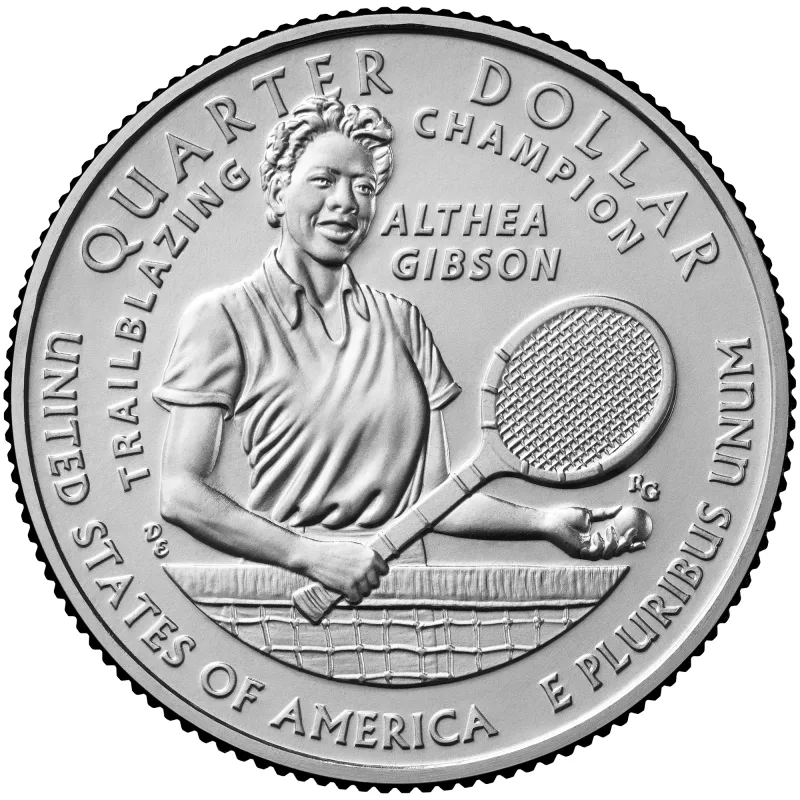
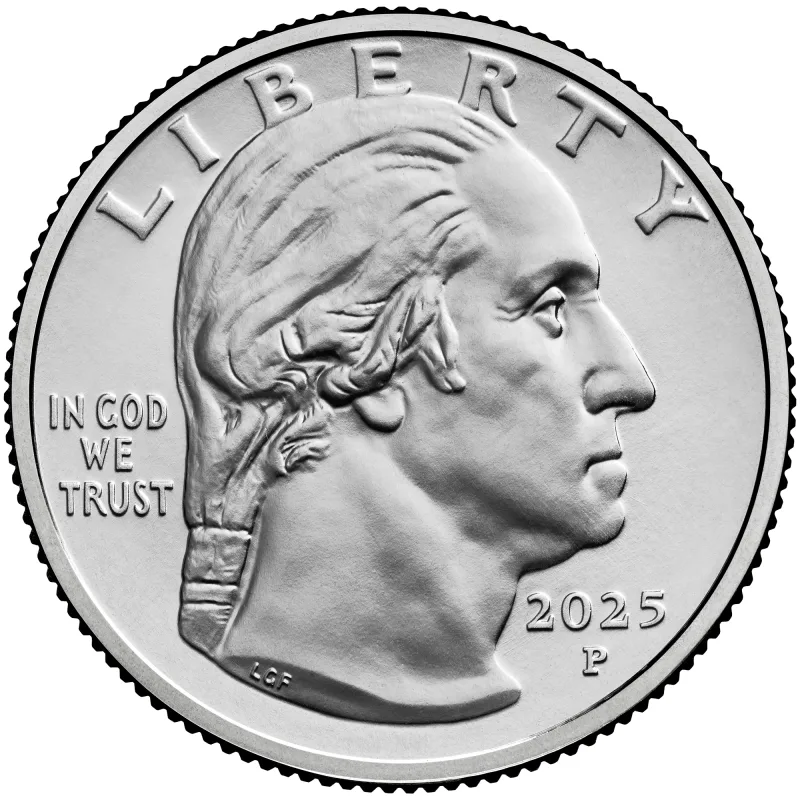
What this coin looks like
Don Everhart's reverse shows Gibson at the net, racquet in her right hand, ball in her left, caught in the moment before a serve. The net runs across the lower third of the coin.
Renata Gordon sculpted it. As the twentieth and final design of the program, this is the coin that closed a series authorized in 2020 and running from January 2022 to October 2025.
The reverse inscriptions read:
- UNITED STATES OF AMERICA
- QUARTER DOLLAR
- ALTHEA GIBSON
- TRAILBLAZING CHAMPION
- E PLURIBUS UNUM
The obverse is the same on all 20 coins in the series: George Washington facing right, with LIBERTY, IN GOD WE TRUST, the date and the mint mark. The mint mark is to the right of Washington's neck, below the date. P is Philadelphia, D is Denver, S is San Francisco and appears only on proof and collector issues.
Is my Althea Gibson quarter an error?
No error or variety unique to this coin is documented in the grading-service and variety sources this site checks. That is the normal situation: only five of the 20 designs (Sally Ride, Wilma Mankiller, Edith Kanakaʻole, Bessie Coleman and Mary Edwards Walker) have a documented error or variety.
What people most often bring to this coin are the three claims that attach to every coin in the series: a faint G in IN GOD WE TRUST (not an error, it is the typeface), flat shiny doubling on the lettering (machine doubling, not a doubled die), and small raised lumps from die chips. The errors page has nine tests that separate a genuine mint error from damage, and the short list of errors that are actually documented in this program.
What is it worth?
| Found in change | 25 cents |
|---|---|
| Uncirculated, from a Mint roll or bag | $1 to $2 |
| Certified mint state | A few dollars, rising to roughly $86 at the top of the population for the series |
| Clad proof (S mint) | Typically less than the cost of grading it |
| Silver proof (S mint, .999 fine) | A floor set by the silver price, plus a small premium |
Values as of October 2026. The full reasoning, including the four cases where a coin in this series is genuinely worth more, is on the value page.
How many were made
| Philadelphia (P) | 117,200,000 |
|---|---|
| Denver (D) | 80,000,000 |
| Total | 197,200,000 |
| Rank in the series | 3 of 20 by mintage, lowest first |
| San Francisco (S) | Not published by the Mint |
San Francisco (S) figures are not shown because the Mint has never published per-design mintages for S-mint American Women Quarters. Any S figure published elsewhere is a secondary-source estimate, and the two most commonly cited sets contradict each other.
See the full mintage table for all 20 designs, or the key date page for where this coin sits in the series.
Collector versions
Besides the Philadelphia and Denver coins in circulation, the Mint sold three San Francisco versions of the 2025 Althea Gibson quarter directly to collectors. None were released into circulation.
| 2025-S uncirculated | Only in the 2025 three-roll set (40 P, 40 D, 40 S), $63.00 at issue |
|---|---|
| 2025-S clad proof | In the 2025 American Women Quarters Proof Set, $26.50 at issue, 33,927 sets sold |
| 2025-S silver proof | In the 2025 American Women Quarters Silver Proof Set, $95.00 at issue, 26,629 sets sold |
Set sales are as reported by CoinNews on 21 October 2026. Details on the proof and silver proof sets and the Mint rolls and bags.
Who was Althea Gibson?
Althea Gibson was born on 25 August 1927 in Silver, Clarendon County, South Carolina, to sharecropper parents. The family moved to Harlem in 1930. Their block of 143rd Street was a Police Athletic League play street, closed to traffic during the day and marked out for games, and that is where she learned paddle tennis. She was New York City's women's paddle tennis champion at twelve.
She was a difficult, truant teenager by her own account, and her way out ran through sport. Local players noticed her, paid for lessons, and got her in front of the American Tennis Association, the Black tennis circuit that existed because the white one excluded her. She won her first ATA event in 1941, took the national girls' title in 1944 and 1945, and from 1947 won ten consecutive ATA women's national championships.
Ten national titles were not enough to get her an entry. The U.S. National Championships were technically open but practically closed, since qualification ran through invitational tournaments at clubs that did not invite her. In 1950 the former champion Alice Marble wrote an open letter to American Lawn Tennis saying that if Gibson was not admitted it would be an indictment of the sport's hypocrisy. Gibson played Forest Hills that year, the first Black player at the U.S. Nationals, days after her twenty-third birthday. She played Wimbledon in 1951.
The titles came later than they should have. She won the French Championships singles in 1956, then Wimbledon and the U.S. Championships in both 1957 and 1958, five Grand Slam singles titles in three years, along with five Grand Slam doubles titles. She was ranked world number one in 1957 and 1958 and was Associated Press Female Athlete of the Year in both, taking over 80 percent of the vote in 1958. New York gave her a ticker-tape parade.
There was no prize money in amateur tennis. Having won everything available to her, she needed an income, and in 1964, at 37, she became the first African American woman on the LPGA Tour. She played professional golf for over a decade, finishing as high as 27th on the money list.
She was inducted into the International Tennis Hall of Fame in 1971 and was among the first six inductees of the International Women's Sports Hall of Fame in 1980. She died in East Orange, New Jersey, on 28 September 2003.
She was selected as the first Black champion in a sport that had kept her out of its tournaments while she won ten consecutive national titles elsewhere.
The design
| Reverse designer | Don Everhart, U.S. Mint Artistic Infusion Program |
|---|---|
| Reverse sculptor | Renata Gordon, U.S. Mint medallic artist |
| Obverse | Laura Gardin Fraser, designed and sculpted, 1931 |
| Released | 20 October 2025 |
Specifications
| Composition, circulating | 91.67% copper, 8.33% nickel (pure copper core, copper-nickel outer layers) |
|---|---|
| Composition, silver proof | .999 fine silver |
| Weight | 5.670 g clad, 6.343 g silver proof |
| Diameter | 24.26 mm |
| Thickness | 1.75 mm |
| Edge | reeded, 119 reeds |
| Mints | Philadelphia (P) and Denver (D) for circulation; San Francisco (S) for proof and collector issues |
No American Women Quarter was struck in 90% silver. The Mint moved its silver proof sets to .999 fine silver with the 2019-dated issues, before this program began.
Frequently asked questions
- How much is the Althea Gibson quarter worth?
- Twenty-five cents in circulated condition. An uncirculated example from a Mint roll or bag trades for one to two dollars.
- How many Althea Gibson quarters were made?
- 197,200,000 in total: 117,200,000 at Philadelphia and 80,000,000 at Denver.
- When was the Althea Gibson quarter released?
- It entered circulation on 20 October 2025.
- Who designed the Althea Gibson quarter?
- The reverse was designed by Don Everhart of the Mint's Artistic Infusion Program and sculpted by U.S. Mint medallic artist Renata Gordon. The obverse, shared by all 20 coins, is by Laura Gardin Fraser.
Sources
- Mintage figures: U.S. Mint circulating coin production dataset.
- Designer and sculptor credits: U.S. Mint, cross-checked against the artists' initials on the coin.
- Coin photograph: United States Mint image.
Last verified: October 2026. Mintage figures are final.