Ida B. Wells Quarter: Value, Mintage and Errors
The 2025 Ida B. Wells quarter is worth 25 cents in circulated condition. 309,400,000 were struck, 166,200,000 at Philadelphia and 143,200,000 at Denver. It was the first coin of the program's final year, released on 2 January 2025.
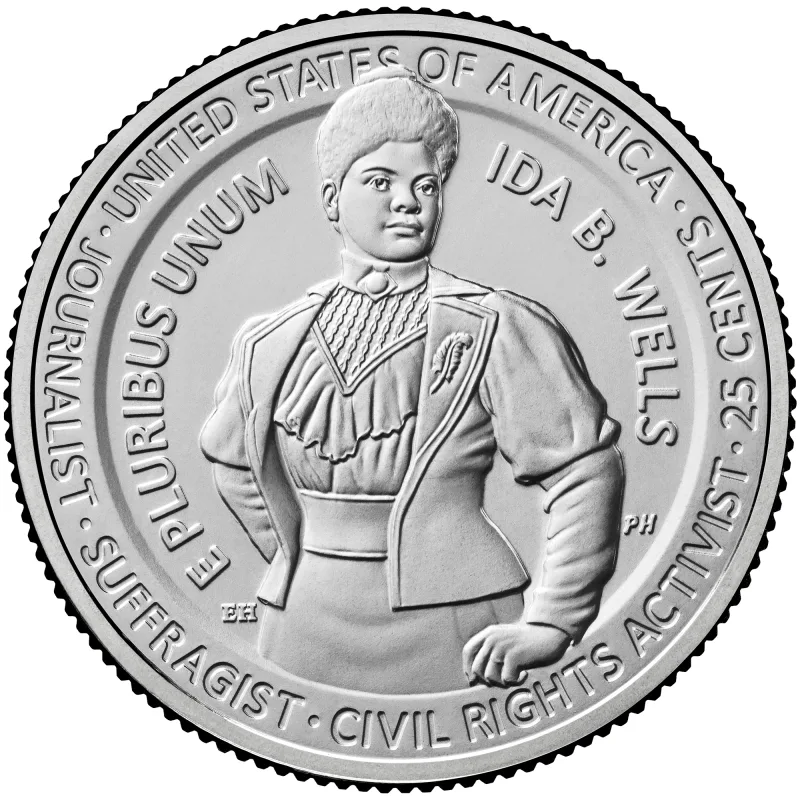
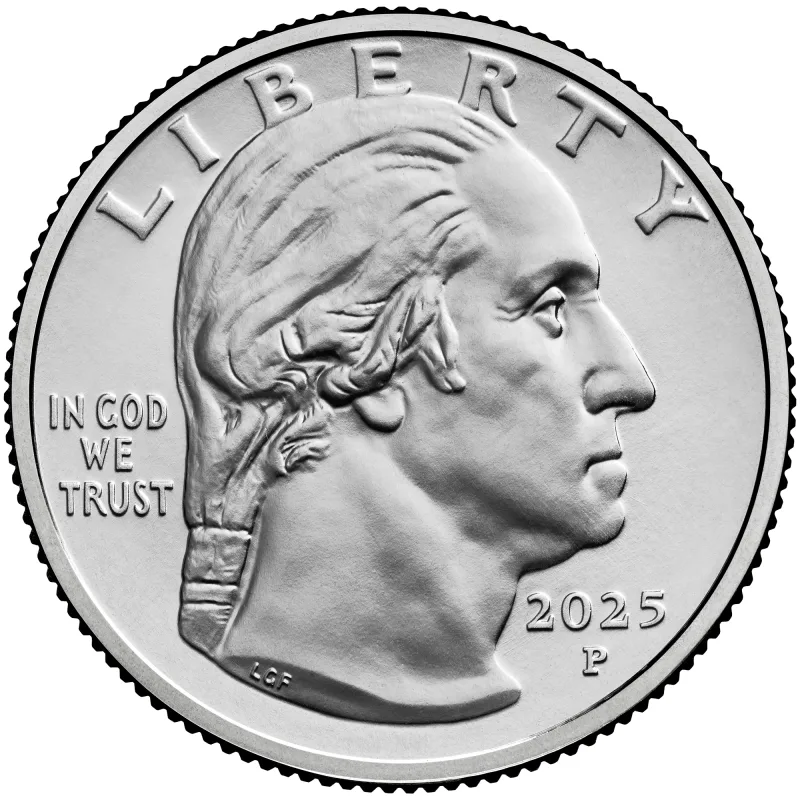
What this coin looks like
Elana Hagler's reverse shows Wells standing, hand resting on a surface, looking directly out of the coin. The three words ringing the lower edge, JOURNALIST, SUFFRAGIST and CIVIL RIGHTS ACTIVIST, are the Mint's summary of why she was chosen, and they are in the order her career took them.
The denomination on this coin reads 25 CENTS rather than QUARTER DOLLAR. Both wordings are used across the series, and both are correct; the choice is the designer's.
The reverse inscriptions read:
- UNITED STATES OF AMERICA
- IDA B. WELLS
- 25 CENTS
- JOURNALIST
- SUFFRAGIST
- CIVIL RIGHTS ACTIVIST
- E PLURIBUS UNUM
The obverse is the same on all 20 coins in the series: George Washington facing right, with LIBERTY, IN GOD WE TRUST, the date and the mint mark. The mint mark is to the right of Washington's neck, below the date. P is Philadelphia, D is Denver, S is San Francisco and appears only on proof and collector issues.
Is my Ida B. Wells quarter an error?
No error or variety unique to this coin is documented in the grading-service and variety sources this site checks. That is the normal situation: only five of the 20 designs (Sally Ride, Wilma Mankiller, Edith Kanakaʻole, Bessie Coleman and Mary Edwards Walker) have a documented error or variety.
What people most often bring to this coin are the three claims that attach to every coin in the series: a faint G in IN GOD WE TRUST (not an error, it is the typeface), flat shiny doubling on the lettering (machine doubling, not a doubled die), and small raised lumps from die chips. The errors page has nine tests that separate a genuine mint error from damage, and the short list of errors that are actually documented in this program.
What is it worth?
| Found in change | 25 cents |
|---|---|
| Uncirculated, from a Mint roll or bag | $1 to $2 |
| Certified mint state | A few dollars, rising to roughly $86 at the top of the population for the series |
| Clad proof (S mint) | Typically less than the cost of grading it |
| Silver proof (S mint, .999 fine) | A floor set by the silver price, plus a small premium |
Values as of October 2026. The full reasoning, including the four cases where a coin in this series is genuinely worth more, is on the value page.
How many were made
| Philadelphia (P) | 166,200,000 |
|---|---|
| Denver (D) | 143,200,000 |
| Total | 309,400,000 |
| Rank in the series | 6 of 20 by mintage, lowest first |
| San Francisco (S) | Not published by the Mint |
San Francisco (S) figures are not shown because the Mint has never published per-design mintages for S-mint American Women Quarters. Any S figure published elsewhere is a secondary-source estimate, and the two most commonly cited sets contradict each other.
See the full mintage table for all 20 designs, or the key date page for where this coin sits in the series.
Collector versions
Besides the Philadelphia and Denver coins in circulation, the Mint sold three San Francisco versions of the 2025 Ida B. Wells quarter directly to collectors. None were released into circulation.
| 2025-S uncirculated | Only in the 2025 three-roll set (40 P, 40 D, 40 S), $63.00 at issue |
|---|---|
| 2025-S clad proof | In the 2025 American Women Quarters Proof Set, $26.50 at issue, 33,927 sets sold |
| 2025-S silver proof | In the 2025 American Women Quarters Silver Proof Set, $95.00 at issue, 26,629 sets sold |
Set sales are as reported by CoinNews on 21 October 2026. Details on the proof and silver proof sets and the Mint rolls and bags.
Who was Ida B. Wells?
Ida Bell Wells was born into slavery on 16 July 1862 near Holly Springs, Mississippi, and freed as an infant by the Emancipation Proclamation. Both parents and a brother died in the 1878 yellow fever epidemic, and at sixteen she took work as a teacher to keep her surviving siblings together. She studied at Shaw University (now Rust College), at Fisk, and at LeMoyne-Owen College in Memphis.
In 1883 a conductor ordered her out of the first-class ladies' car on the Chesapeake and Ohio Railway. She bit his hand, was dragged off the train, and sued. A Memphis circuit court awarded her $500 on 24 December 1884. The Tennessee Supreme Court reversed it in 1887 and ordered her to pay costs. She had already begun writing about it.
By 1889 she was editor and co-owner of the Free Speech and Headlight in Memphis. On 9 March 1892 three of her friends, Thomas Moss, Calvin McDowell and William Stewart, were taken from the Shelby County Jail and lynched after their grocery competed successfully with a white-owned store. That killing redirected the rest of her life. She investigated lynching as a journalist does, case by case, and published what the records actually showed: that the rape accusation used to justify these killings was in most cases absent from the record entirely.
She printed that conclusion in May 1892. A white mob destroyed the Free Speech office while she was in New York. She never returned to Memphis. From the New York Age she published Southern Horrors: Lynch Law in All Its Phases (1892) and A Red Record (1895), the first statistical studies of lynching in the United States.
She married the attorney Ferdinand Lee Barnett in Chicago on 27 June 1895. With Belle Squire she founded the Alpha Suffrage Club there on 30 January 1913, the first Black women's suffrage organization in the city. At the Washington suffrage parade that year she was told to walk at the back with a segregated delegation; she waited on the sidewalk and stepped in with the Illinois delegation as it passed. She was among the founders of the NAACP. She ran for the Illinois Senate as an independent in 1930 and lost, and died in Chicago of kidney disease on 25 March 1931.
In 2020 she received a posthumous Pulitzer Prize special citation for, in the board's words, her reporting on violence against African Americans during the era of lynching.
She was selected for the program as a journalist whose method, verifying every case against the record, was itself the argument.
The design
| Reverse designer | Elana Hagler, U.S. Mint Artistic Infusion Program |
|---|---|
| Reverse sculptor | Phebe Hemphill, U.S. Mint medallic artist |
| Obverse | Laura Gardin Fraser, designed and sculpted, 1931 |
| Released | 2 January 2025 |
Specifications
| Composition, circulating | 91.67% copper, 8.33% nickel (pure copper core, copper-nickel outer layers) |
|---|---|
| Composition, silver proof | .999 fine silver |
| Weight | 5.670 g clad, 6.343 g silver proof |
| Diameter | 24.26 mm |
| Thickness | 1.75 mm |
| Edge | reeded, 119 reeds |
| Mints | Philadelphia (P) and Denver (D) for circulation; San Francisco (S) for proof and collector issues |
No American Women Quarter was struck in 90% silver. The Mint moved its silver proof sets to .999 fine silver with the 2019-dated issues, before this program began.
Frequently asked questions
- How much is the Ida B. Wells quarter worth?
- Twenty-five cents in circulated condition. An uncirculated example from a Mint roll or bag trades for one to two dollars.
- How many Ida B. Wells quarters were made?
- 309,400,000 in total: 166,200,000 at Philadelphia and 143,200,000 at Denver.
- When was the Ida B. Wells quarter released?
- It entered circulation on 2 January 2025.
- Who designed the Ida B. Wells quarter?
- The reverse was designed by Elana Hagler of the Mint's Artistic Infusion Program and sculpted by U.S. Mint medallic artist Phebe Hemphill. The obverse, shared by all 20 coins, is by Laura Gardin Fraser.
Sources
- Mintage figures: U.S. Mint circulating coin production dataset.
- Designer and sculptor credits: U.S. Mint, cross-checked against the artists' initials on the coin.
- Coin photograph: United States Mint image.
Last verified: October 2026. Mintage figures are final.