Edith Kanakaʻole Quarter: Value, Mintage and Errors
The 2023 Edith Kanakaʻole quarter is worth 25 cents in circulated condition. 741,400,000 were struck, 372,800,000 at Philadelphia and 368,600,000 at Denver. Released on 27 March 2023, it was the second coin of 2023 and the seventh in the program. It is the only 2023 American Women quarter whose reverse carries a phrase in Hawaiian, "E hō mai ka ʻike" ("granting the wisdom").
What this coin looks like
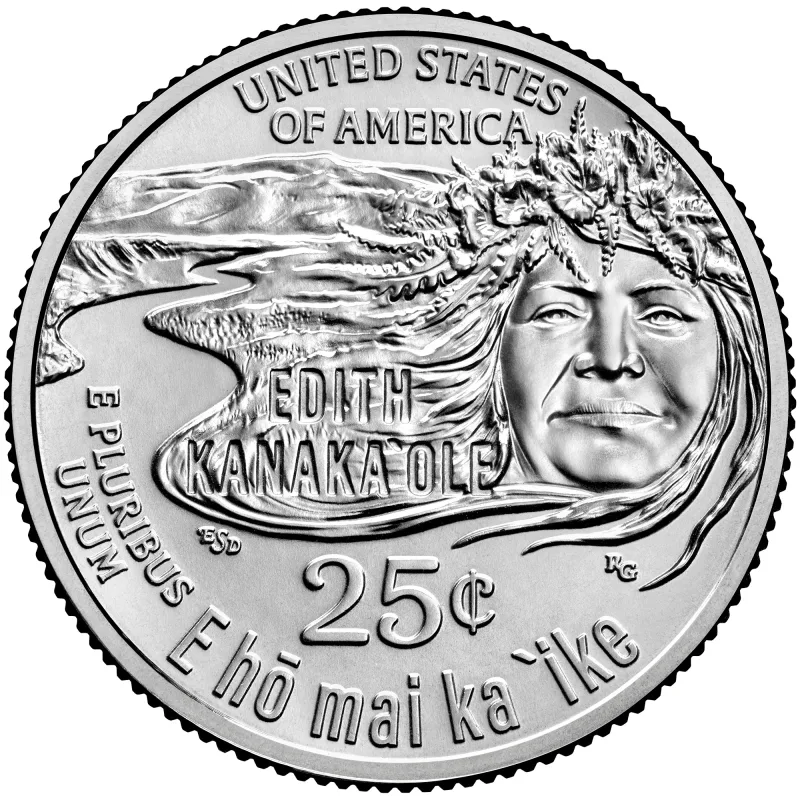
The reverse depicts a portrait of Edith Kanakaʻole with her hair and lei poʻo (head lei) morphing into the elements of a Hawaiian landscape. The Mint describes this as symbolizing her life's work of preserving the natural land and traditional Hawaiian culture. The inscription "E hō mai ka ʻike" translates, the Mint says, as "granting the wisdom," a reference to the intertwined role hula and chants play in that preservation. The denomination appears as 25¢ rather than QUARTER DOLLAR.
The design is by Artistic Infusion Program designer Emily Damstra, and it was sculpted by U.S. Mint Medallic Artist Renata Gordon. In the Mint's release, Damstra said that Kanakaʻole's deep connection to the land, and her home near the Mauna Kea volcano, "played a large role in her life and work." The Mint began shipping the quarter on 27 March 2023 as the second coin of the 2023 series.
The reverse inscriptions read:
- E hō mai ka ʻike
- UNITED STATES OF AMERICA
- E PLURIBUS UNUM
- 25¢
- EDITH KANAKAʻOLE
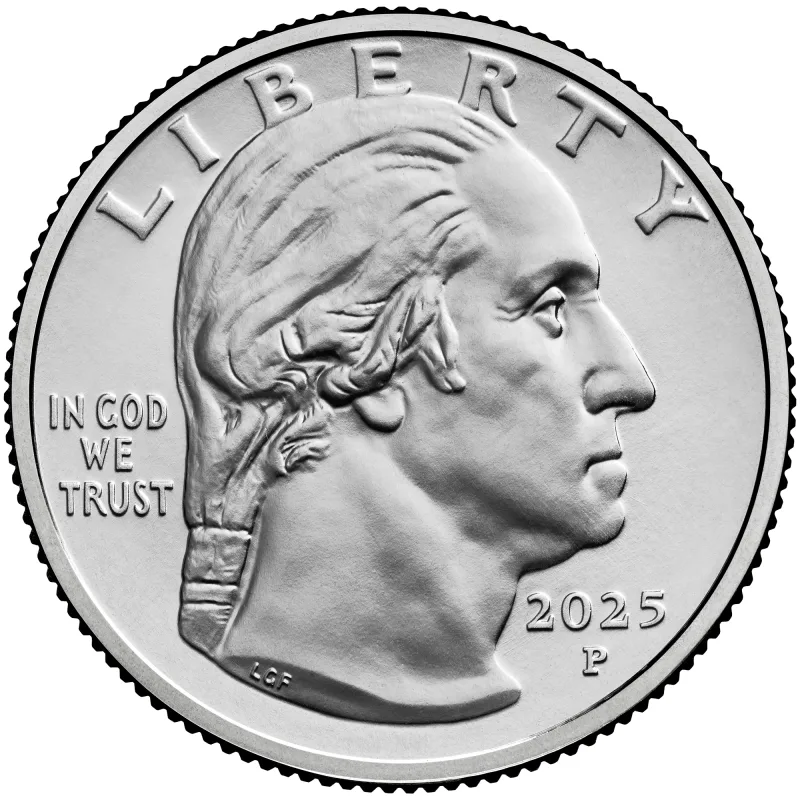
The obverse is the same on all 20 coins in the series: George Washington facing right, with LIBERTY, IN GOD WE TRUST, the date and the mint mark. The mint mark is to the right of Washington's neck, below the date. P is Philadelphia, D is Denver, S is San Francisco and appears only on proof and collector issues.
Is my Edith Kanakaʻole quarter an error?
One major die clash is documented: VCR#1/CDOR#1, in which the reverse die left the letters EDITH imprinted across Washington's profile on the obverse. Ken Potter compared it to the 1888-O VAM 1A "Scarface" Morgan dollar. At least 11 examples are known. The published reports disagree on whether it is a Philadelphia or Denver coin, and no sale price has been published, so this site does not give one.
What people most often bring to this coin are the three claims that attach to every coin in the series: a faint G in IN GOD WE TRUST (not an error, it is the typeface), flat shiny doubling on the lettering (machine doubling, not a doubled die), and small raised lumps from die chips. The errors page has nine tests that separate a genuine mint error from damage, and the short list of errors that are actually documented in this program.
What is it worth?
| Found in change | 25 cents |
|---|---|
| Uncirculated, from a Mint roll or bag | $1 to $2 |
| Certified mint state | A few dollars, rising to roughly $86 at the top of the population for the series |
| Clad proof (S mint) | Typically less than the cost of grading it |
| Silver proof (S mint, .999 fine) | A floor set by the silver price, plus a small premium |
Values as of October 2026. The full reasoning, including the four cases where a coin in this series is genuinely worth more, is on the value page.
How many were made
| Philadelphia (P) | 372,800,000 |
|---|---|
| Denver (D) | 368,600,000 |
| Total | 741,400,000 |
| Rank in the series | 20 of 20 by mintage, lowest first |
| San Francisco (S) | Not published by the Mint |
San Francisco (S) figures are not shown because the Mint has never published per-design mintages for S-mint American Women Quarters. Any S figure published elsewhere is a secondary-source estimate, and the two most commonly cited sets contradict each other.
See the full mintage table for all 20 designs, or the key date page for where this coin sits in the series.
Collector versions
Besides the Philadelphia and Denver coins in circulation, the Mint sold three San Francisco versions of the 2023 Edith Kanakaʻole quarter directly to collectors. None were released into circulation.
| 2023-S uncirculated | Only in the 2023 three-roll set (40 P, 40 D, 40 S), $60.00 at issue |
|---|---|
| 2023-S clad proof | In the 2023 American Women Quarters Proof Set, $23.00 at issue, 60,934 sets sold |
| 2023-S silver proof | In the 2023 American Women Quarters Silver Proof Set, $80.00 at issue, 47,278 sets sold |
Set sales are as reported by CoinNews on 21 October 2026. Details on the proof and silver proof sets and the Mint rolls and bags.
Who was Edith Kanakaʻole?
Edith Kanakaʻole was born Edith Kenao on 30 October 1913 in Honomū, on the island of Hawaiʻi. She was one of 12 children; her mother, Mary, was a hula teacher, and her father, John, was a musician. She later became widely known as "Aunty Edith."
She studied oli (chant) and hula with her mother as a child and later trained under the kumu hula Akoni Mika. On 21 January 1933 she married Luka Kanakaʻole, and they had six children, among them the daughters Nalani Kanakaʻole and Pualani Kanakaʻole Kanahele. In the 1950s she toured the contiguous United States, western Canada and much of Asia with a hula group named after Nalani.
In 1953, after her mother's death, she founded Hālau O Kekuhi, a hula school created in her mother's honor that still operates today. She composed oli and songs, often choreographing hula to accompany them, and became fluent in Hawaiian in order to understand the layered meanings of the chants. The Mint says her moʻolelo (stories) helped rescue aspects of Hawaiian history, customs and traditions that were disappearing.
In 1971 she stepped back from performing and turned to teaching. She helped develop the first Hawaiian language program for public school students, at Keaukaha School in Hilo. She taught at Hawaiʻi Community College from 1971 to 1979 and at the University of Hawaiʻi at Hilo from 1973 to 1979, helping to build courses and seminars in ethnobotany, Polynesian history, genealogy, land ownership, and Hawaiian chant and mythology. At UH Hilo she became the lead Hawaiian language teacher and supported the effort to establish a bachelor's degree in Hawaiian studies. She was also concerned about disputes between Native Hawaiians and the government over lands of spiritual significance. The Mint records her philosophy as "Teach all who come."
Her first album, Haakui Pele I Hawaiʻi, won the Nā Hōkū Hanohano Award for best traditional album in 1978, and her second, Hiipoi I Ka Aiina Aloha, won the same award in 1979 after her death. She was named Hawaiian of the Year in 1977. In 1979 Governor George Ariyoshi presented her with the Distinction of Cultural Leadership award, the state's highest honor in that field, and she also received the Order of Ke Aliʻi Pauahi that year.
She died of cancer on 3 October 1979, at 65. Her daughters Nalani and Pualani took over Hālau O Kekuhi, and in 1993 they received a National Heritage Fellowship from the National Endowment for the Arts. Her family established the Edith Kanakaʻole Foundation in 1990 to carry on the teachings of Edith and Luka Kanakaʻole; it runs a public charter school in Keaukaha. The Edith Kanakaʻole Multi-Purpose Stadium in Hilo, named for her, hosts the Merrie Monarch Festival each year.
She was selected as an Indigenous Hawaiian composer, chanter, dancer, teacher and entertainer who, in the Mint's words, preserved Native Hawaiian knowledge, culture, traditions and history through hula and chanting.
The design
| Reverse designer | Emily Damstra, U.S. Mint Artistic Infusion Program |
|---|---|
| Reverse sculptor | Renata Gordon, U.S. Mint medallic artist |
| Obverse | Laura Gardin Fraser, designed and sculpted, 1931 |
| Released | 27 March 2023 |
Specifications
| Composition, circulating | 91.67% copper, 8.33% nickel (pure copper core, copper-nickel outer layers) |
|---|---|
| Composition, silver proof | .999 fine silver |
| Weight | 5.670 g clad, 6.343 g silver proof |
| Diameter | 24.26 mm |
| Thickness | 1.75 mm |
| Edge | reeded, 119 reeds |
| Mints | Philadelphia (P) and Denver (D) for circulation; San Francisco (S) for proof and collector issues |
No American Women Quarter was struck in 90% silver. The Mint moved its silver proof sets to .999 fine silver with the 2019-dated issues, before this program began.
Frequently asked questions
- How much is the Edith Kanakaʻole quarter worth?
- Twenty-five cents in circulated condition. An uncirculated example from a Mint roll or bag trades for one to two dollars.
- How many Edith Kanakaʻole quarters were made?
- 741,400,000 in total: 372,800,000 at Philadelphia and 368,600,000 at Denver.
- When was the Edith Kanakaʻole quarter released?
- It entered circulation on 27 March 2023.
- Who designed the Edith Kanakaʻole quarter?
- The reverse was designed by Emily Damstra of the Mint's Artistic Infusion Program and sculpted by U.S. Mint medallic artist Renata Gordon. The obverse, shared by all 20 coins, is by Laura Gardin Fraser.
- What does "E hō mai ka ʻike" on the Edith Kanakaʻole quarter mean?
- The U.S. Mint translates it as "granting the wisdom" and says it refers to the intertwined role hula and chants play in preserving Hawaiian culture.
- What is on the back of the Edith Kanakaʻole quarter?
- A portrait of Edith Kanakaʻole whose hair and lei poʻo morph into a Hawaiian landscape, designed by Emily Damstra and sculpted by Renata Gordon.
Sources
- Mintage figures: U.S. Mint circulating coin production dataset.
- Designer and sculptor credits: U.S. Mint, cross-checked against the artists' initials on the coin.
- Coin photograph: United States Mint image.
- U.S. Mint: United States Mint Begins Shipping 2023 American Women Quarters Program Coins Honoring Edith Kanakaʻole on March 27
- U.S. Mint: United States Mint Announces Designs for 2023 American Women Quarters Program Coins
- U.S. Mint: United States Mint Announces 2023 American Women Quarters Program Honorees
- U.S. Mint: We Hoʻokupu (We Pay Tribute)
- Wikipedia: Edith Kanakaʻole
- National Women's History Museum: Edith Kanaka'ole
- Congressional Record, 20 July 2023, S3456
- Notable Folklorists of Color: Edith Kenao Kanakaʻole
Last verified: October 2026. Mintage figures are final.