Native American Quarters: The Three Native Women on the Coin
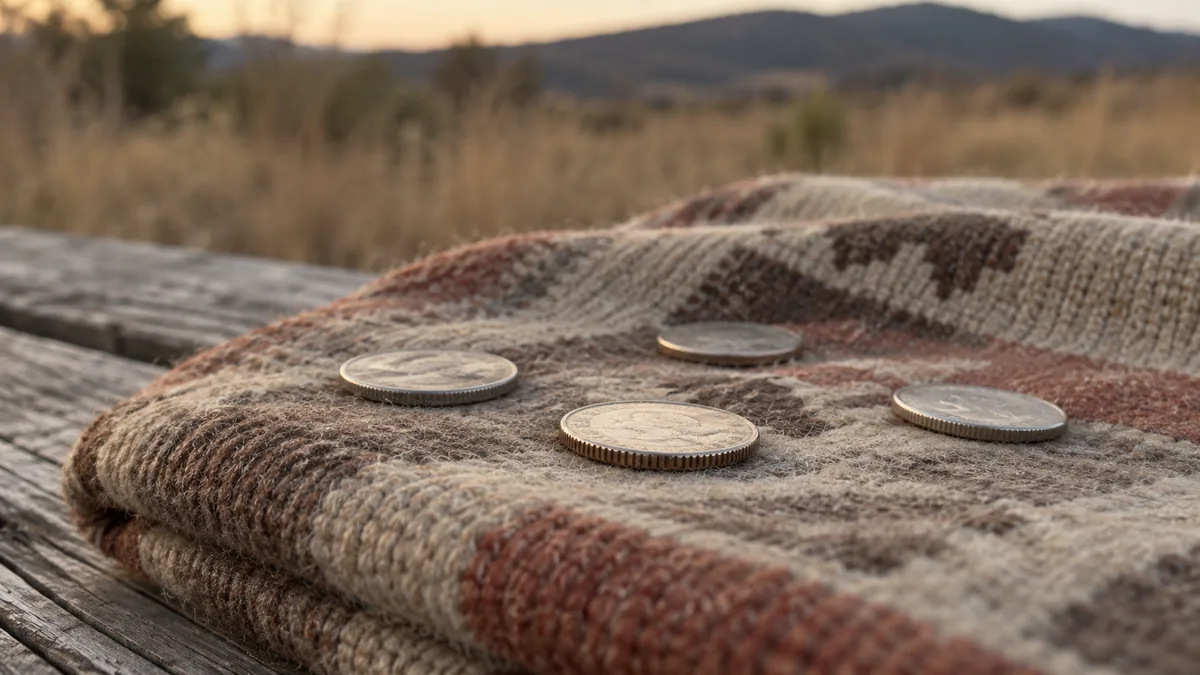
There is no single "Native American quarter." Three American Women Quarters honor Native American women: Wilma Mankiller of the Cherokee Nation (2022), the Osage ballerina Maria Tallchief (2023) and Zitkala-Ša, a Yankton Sioux writer and activist (2024). The coin the Mint actually names for Native Americans is a dollar, the Native American $1 Coin, issued every year since 2009.
Both are easy to mix up in a search, and in a coin jar. This post covers the three quarters first, then the dollar coin, then how to tell which one you are holding.
Native American quarter or Native American dollar
| Coin | Denomination | Date | Native element on the design |
|---|---|---|---|
| Wilma Mankiller quarter | 25 cents | 2022 | CHEROKEE NATION in the Cherokee syllabary; the Cherokee Nation's seven-pointed star |
| Maria Tallchief quarter | 25 cents | 2023 | Her Osage name in Osage orthography |
| Zitkala-Ša quarter | 25 cents | 2024 | Yankton Sioux dress, a cardinal for her name, a Yankton Sioux-inspired diamond pattern |
| Sacagawea Golden Dollar | $1 | 2000 to 2008 | Sacagawea carrying her infant son |
| Native American $1 Coin | $1 | 2009 to date | Sacagawea on the front; a new Native American theme on the back each year |
The quickest test is color. The three quarters are the usual silver-colored copper-nickel clad. Both dollar series are golden in color; the Sacagawea dollar gets its color from an outer layer of manganese brass.
The Wilma Mankiller quarter (2022)
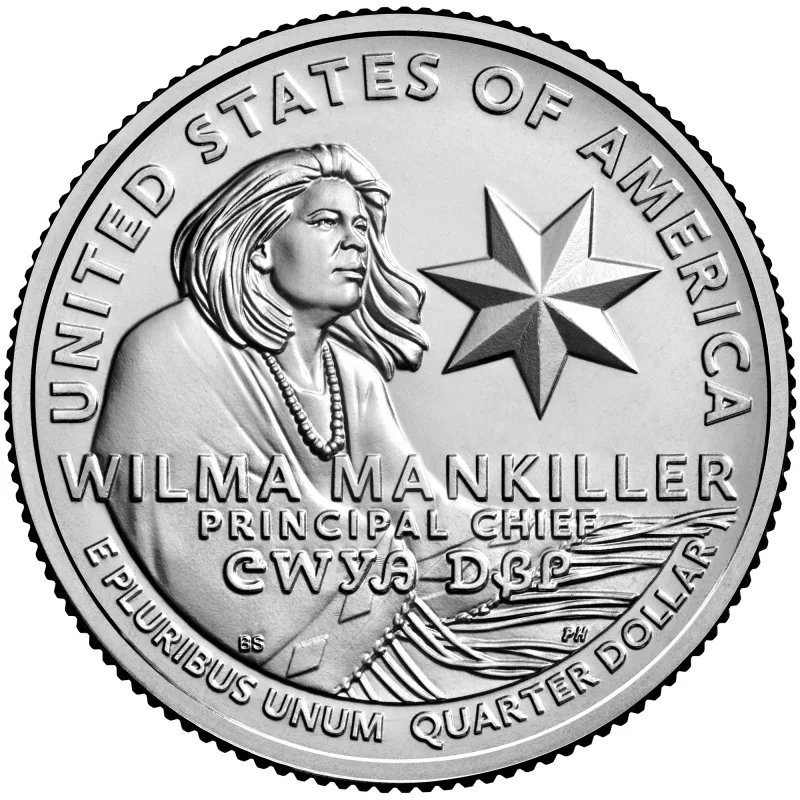
The third American Women Quarter shows Mankiller wrapped in a traditional shawl, the wind at her back, with the seven-pointed star of the Cherokee Nation to her left. Two of the inscriptions, PRINCIPAL CHIEF and CHEROKEE NATION, say who she was; the second is written in the Cherokee syllabary rather than Latin letters. Ben Sowards designed it and Phebe Hemphill sculpted it. It was released on 6 June 2022.
Mankiller became deputy chief of the Cherokee Nation in 1983 and was sworn in as Principal Chief on 5 December 1985, the first woman to hold the office. In 1987 she won a run-off to become the first woman elected principal chief, and in 1991 she was re-elected with 83 percent of the vote. In 1998 she received the Presidential Medal of Freedom.
It is also the coin in the series with the most documented errors, including a 2022-D struck on a nickel planchet. Each is a single certified coin, not something to expect in change. The full design notes and biography are on the Wilma Mankiller quarter page.
The Maria Tallchief quarter (2023)
The last coin of 2023, released on 23 October, shows Tallchief spotlit in a ballet pose with her Osage name, which the Mint translates as "Two Standards," written in Osage orthography. The Mint says the name was chosen by her grandmother and reflects her life in two worlds, as a dancer and as a member of the Osage Nation. Ben Sowards designed this one too, and Chief Engraver Joseph Menna sculpted it.
Born in Fairfax, Oklahoma, in 1925, Tallchief became New York City Ballet's first prima ballerina and created the title role in Balanchine's The Firebird in 1949. She received a Kennedy Center Honor in 1996 and the National Medal of Arts in 1999. See the Maria Tallchief quarter page for more.
She is also the one person in this post on two coins dated 2023. The 2023 Native American $1 Coin shows her in a ballet pose under the words AMERICAN INDIANS IN BALLET, with four other Oklahoma ballerinas in the background: her sister Marjorie Tallchief, Yvonne Chouteau, Rosella Hightower and Moscelyne Larkin. Sowards designed that reverse as well.
The Zitkala-Ša quarter (2024)
Released on 21 October 2024 as the last coin of that year, this quarter shows Zitkala-Ša in traditional Yankton Sioux dress holding a book. Behind her is a stylized sun for The Sun Dance Opera, which she co-wrote, and a cardinal, because her name translates to "Red Bird." The words AUTHOR, ACTIVIST and COMPOSER run around her. Don Everhart designed it and Renata Gordon sculpted it.
Born on the Yankton Indian Reservation in 1876, she published Old Indian Legends in 1901, wrote the libretto and songs for The Sun Dance Opera (first performed in 1913), and campaigned for Native Americans' right to U.S. citizenship. Congress granted it to most Native people in the Indian Citizenship Act of 1924. In 1926 she co-founded the National Council of American Indians. More on the Zitkala-Ša quarter page.
The same law turned up on a coin the same year: the theme of the 2024 Native American $1 Coin is the Indian Citizenship Act of 1924, shown with an eagle staff.
Native American women quarters by the numbers
| Honoree | Nation | Year | Philadelphia (P) | Denver (D) | Total |
|---|---|---|---|---|---|
| Wilma Mankiller | Cherokee | 2022 | 310,000,000 | 297,400,000 | 607,400,000 |
| Maria Tallchief | Osage | 2023 | 185,800,000 | 184,800,000 | 370,600,000 |
| Zitkala-Ša | Yankton Sioux | 2024 | 152,600,000 | 170,200,000 | 322,800,000 |
All three were struck in the hundreds of millions. A circulated example of any of them is worth 25 cents, and an uncirculated coin from a Mint roll or bag trades for about one to two dollars. San Francisco versions exist for each, sold to collectors in three-roll sets and proof sets, and the reported S uncirculated figures, worked out from three-roll set sales, are 304,640 for Mankiller, 502,200 for Tallchief and 430,280 for Zitkala-Ša. The mintage table has all 20 coins for comparison.
The Native American $1 coin is a dollar, not a quarter
From 2000 to 2008 the Mint struck the Sacagawea Golden Dollar. Glenna Goodacre's obverse shows Sacagawea carrying her infant son, Jean Baptiste; her model was a Shoshone college student, Randy'L He-dow Teton.
In 2009 the Native American $1 Coin Program began under the Native American One Dollar Coin Act (Public Law 110-82). Sacagawea stayed on the obverse and the reverse began to change every year, each design honoring a contribution of Indian tribes or individual Native Americans. The first, by Norman E. Nemeth, showed a Native American woman planting corn, beans and squash, the Three Sisters method. The year, mint mark and E PLURIBUS UNUM are on the edge, not the faces. The 2022 coin honored Ely S. Parker.
You are unlikely to get one of the recent ones in change. According to CoinNews, the series was struck for circulation as well as for collectors until 2012, when the Mint began producing it only for numismatic products. Rolls, bags and boxes are sold through the Mint and contain circulation-quality coins that were never released.
Collecting the three as a group
A small Native American women set is three quarters from Philadelphia and three from Denver, six coins in all, and every one of them can still turn up in a bank roll. The Mankiller quarter, with over 600 million struck, is the easiest. The Tallchief and Zitkala-Ša coins, at 370,600,000 and 322,800,000, take a little longer.
The Mint's annual sets pair the two programs neatly. The 2023 United States Mint Uncirculated Coin Set holds the five 2023 women's quarters and the Maria Tallchief dollar on each of its two cards, so each card carries Tallchief twice. Proof and silver proof versions of each quarter are in the yearly American Women Quarters proof sets.
How to tell which coin you have
Silver-colored, reeded edge, Washington on the front: it is a quarter, and one of the three above if the back names Mankiller, Tallchief or Zitkala-Ša. Golden, with Sacagawea on the front: it is a dollar. If the year and mint mark are on the edge rather than the face, it is a Native American $1 Coin from 2009 or later, and the back tells you that year's theme.
If you are building a set of the quarters, the American Women Quarters checklist lists all 20 with P and D boxes, and our list of quarters by year puts each one in order with its release date.
Frequently asked questions
- Is a Native American quarter worth anything?
- A circulated Mankiller, Tallchief or Zitkala-Ša quarter is worth 25 cents, and an uncirculated one from a Mint roll or bag trades for about one to two dollars. A handful of individually certified Mankiller errors exist, but nothing in ordinary change is one of them.
- Is the Sacagawea coin a quarter?
- No. Sacagawea is on dollar coins: the golden Sacagawea dollar of 2000 to 2008 and the Native American $1 Coin since 2009. The only Native American women on quarters are Wilma Mankiller, Maria Tallchief and Zitkala-Ša.
- What does the Cherokee writing on the Mankiller quarter mean?
- The syllabary inscription reads CHEROKEE NATION, the nation Wilma Mankiller led as principal chief. The other inscriptions, including PRINCIPAL CHIEF and her name, are in English.
- Is there a Native Hawaiian woman on a quarter?
- Yes. The 2023 Edith Kanakaʻole quarter honors a Native Hawaiian composer, chanter, dancer and teacher. Its reverse carries the Hawaiian inscription E hō mai ka ʻike, which the Mint translates as granting the wisdom.
- Why is there a red bird on the Zitkala-Ša quarter?
- The bird is a cardinal, and it stands for her name. Zitkala-Ša translates to Red Bird. The sun behind her stands for The Sun Dance Opera, the work she created with the composer William F. Hanson.
Sources
- U.S. Mint, Native American $1 Coin Collection
- U.S. Mint, Mint releases designs for Native American $1 coin (28 November 2008)
- U.S. Mint, United States Mint announces 2023 Native American $1 Coin reverse design
- U.S. Mint, 2024 Native American $1 Coin: Indian Citizenship Act of 1924
- U.S. Mint, Sacagawea Golden Dollar
- CoinNews, 2024 Native American $1 Coins released in rolls, bags and boxes (29 January 2024)
- U.S. Mint, 2023 United States Mint Uncirculated Coin Set available December 5
- CoinNews, U.S. Mint 2022 Proof Set release (7 April 2022)
Last verified: October 2026. Mintage figures are final.